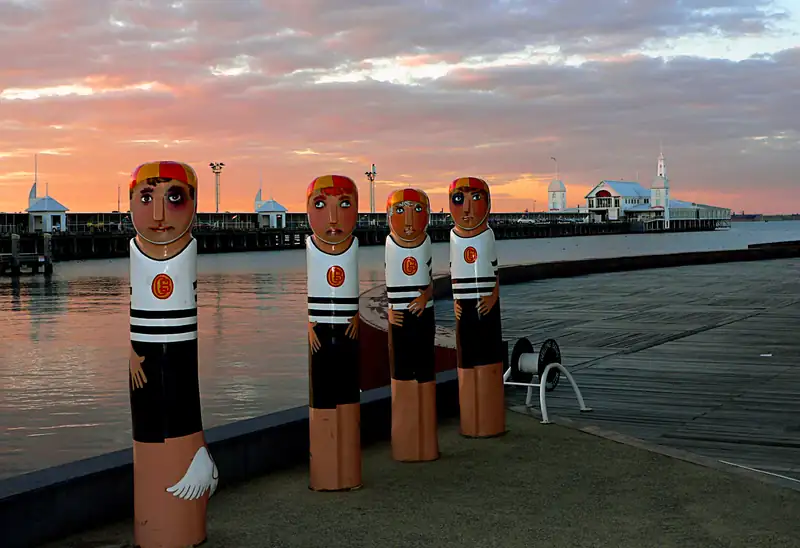
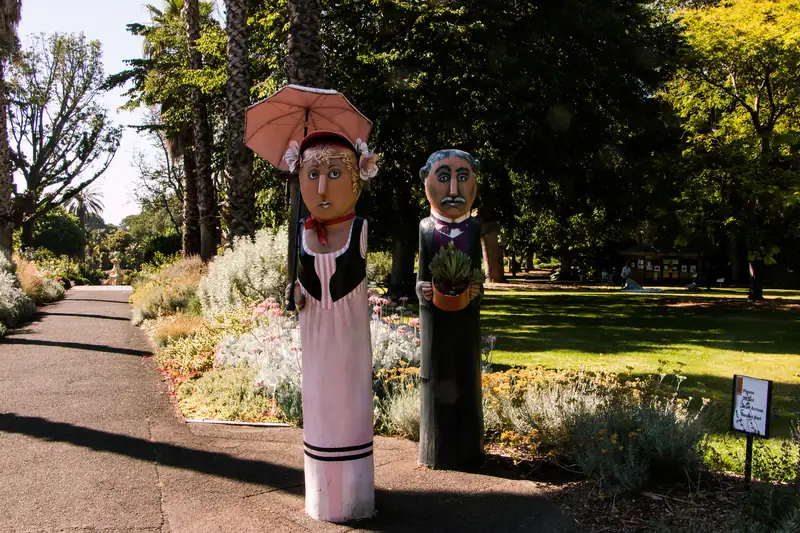
The Geelong bollards are painted wooden figures by artist Jan Mitchell, carved from old wharf pylons between 1994 and 1999. The council says about 104 were made at first and there are now over 155. Most stand along the waterfront trail from Rippleside Park to Limeburners Point, about 4 km, free to walk.
The Geelong bollards are the painted wooden figures that line the city’s waterfront: sea captains, lifesavers, bathing beauties, a fireman, a brass band. Artist Jan Mitchell carved and painted them between 1994 and 1999 from recovered wharf pylons. The City of Greater Geelong says about 104 were made at first and there are now more than 155 across the region. You can see most of them for free on a walk along Corio Bay from Rippleside Park to Limeburners Point.
How many bollards are there?
It depends on who is counting and when. The council’s trail page, updated in August 2026, says the project “began with approximately 104 works” and has grown to “over 155”. A Weekend Notes article counted 103 bollards at 48 sites along the waterfront trail. Jan Mitchell’s Wikipedia entry says there were “over 100” by 1999.
The higher number includes bollards away from the bay walk. The council lists them from Barwon Heads to Portarlington, and across Geelong at the Carousel, the National Wool Museum, the visitor information centres and Avalon Airport. If you only walk the waterfront, expect to see something over 100.
What are they made of?
Timber. Mitchell worked with recovered wharf pylons, the thick posts that once held up the piers, and painted them in acrylic. Each figure is a single post, shaped and painted to look like a person in period dress. They are sculptures, not working bollards: nothing is tied up to them.
The history and Jan Mitchell
Jan Mitchell was born in Melbourne in 1940. She spent close to 20 years overseas, much of it as a graphic artist in Irish television, before coming home. Her first bollard art was made in Barwon Heads through an artist-in-schools program. In 1994 she presented the Baywalk Bollards idea to the commissioners then running the City of Greater Geelong, and the waterfront set was finished by 1999, the same years the waterfront itself was being rebuilt.
The figures tell Geelong’s own story from the 19th and 20th centuries. The council’s curated trail names them: Victoria Baths swimmers, sea captains, a sailor and a woman, the Volunteer Rifle Band, a tram conductress, scallop fishers, a fireman, an early Geelong footballer, a Pierrot, a sandwich-board man for the Joy Ark, bathing beauties and the Eastern Beach lifesavers. One pair shows Ian McDonald and Robert Johnston; McDonald was the city engineer who designed the Eastern Beach bathing complex in the 1930s.
Mitchell died in Geelong in March 2008. Her bollards can also be seen at Melbourne and Avalon airports.
Bollards beyond the waterfront
The bollards started outside the city. Mitchell’s first bollard art was made in Barwon Heads, and the council says the collection now reaches from Barwon Heads to Portarlington along the bay. Inside Geelong you will also find figures at the Carousel, the National Wool Museum and the visitor information centres, and a few greet passengers at Avalon Airport. None of these are on a marked route, so treat them as a bonus if you are passing.
The bollard trail walk
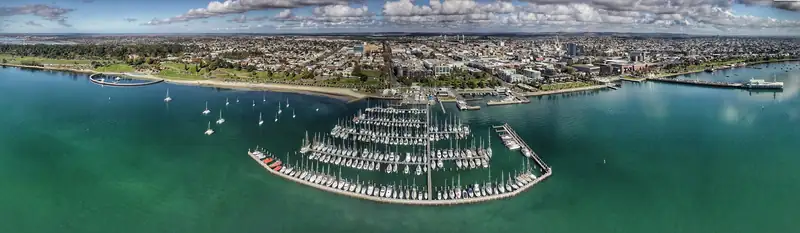
The council describes the trail as running from Rippleside Park in the north-west, along the bay, to Limeburners Point and the Botanic Gardens. Here is how it breaks down:
| Section |
Start |
End |
Distance |
What you pass |
| North-west |
Rippleside Park |
Cunningham Pier |
About 1.8 km |
Quieter foreshore, Western Beach, the convention centre |
| Central |
Cunningham Pier |
Eastern Beach enclosure |
About 1.1 km |
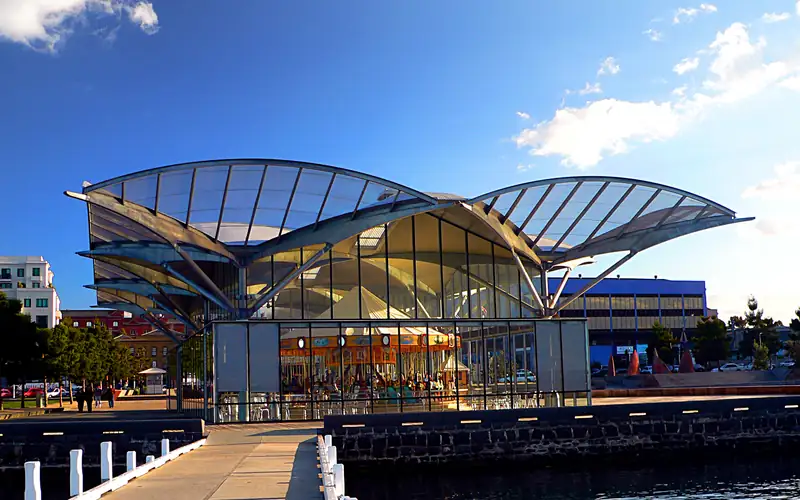
Steampacket Gardens, the Carousel, the densest run of bollards |
| East |
Eastern Beach enclosure |
Limeburners Point |
About 1.1 km |
The 1930s baths, Eastern Beach Reserve, the foot of Eastern Park |
| Whole trail |
Rippleside Park |
Limeburners Point |
About 4 km |
All of the above |
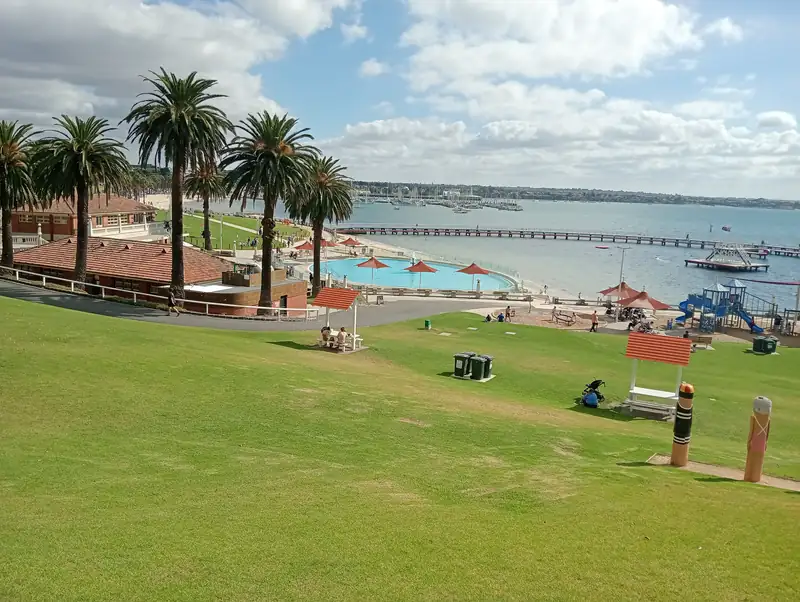
Checked October 2026. Distances are straight lines between map points along the shore, so the path you walk is a little longer. The council estimates 30 minutes one way and an hour return, which fits the central section better than the whole 4 km.
There is no ticket, no gate and no opening time. The bollards stand outdoors on public foreshore, so you can walk the trail at any hour.
Which way to walk
Walk west to east. You start at the quiet end and finish at Eastern Beach, where you can swim or sit in the reserve, and the Botanic Gardens are a short climb from Limeburners Point. If you only have an hour, skip the north-west section: start at Cunningham Pier, a 0.7 km walk from Geelong railway station, and walk east.
Some suggestions for the central stretch:
- The bathing beauties and swimming club figures make more sense once you have seen the Eastern Beach enclosure, which was the city’s main swimming spot from the 1930s.
- Kids tend to hunt for the fireman and the footballer. The Geelong with kids guide has more ideas for a family day.
Getting there and parking
The train from Southern Cross in Melbourne takes about an hour. From Geelong station it is about 0.7 km to the Carousel and the middle of the trail. Drivers can use the Western Beach car park beside Cunningham Pier ($3.80 an hour, three-hour limit, checked October 2026), the free all-day streets above Eastern Beach, or the Civic Centre car park on Gheringhap Street, which the National Wool Museum says is free after 6 pm on Fridays and all weekend. See the Geelong parking guide for the rest.
The waterfront is an on-leash area for dogs under council rules.
Seeing the bollards on a tour
There is no guided bollard walk on GetYourGuide. The closest is the Bay Sightseeing and Ferry Ride day tour from Melbourne, which starts with a walk past the bollards on the Geelong waterfront before heading to Point Lonsdale, Queenscliff and the ferry to Sorrento. It suits visitors without a car who want the bollards and the Bellarine in one day.
For everything else on the bay, from the Carousel to Cunningham Pier, start with the Geelong Waterfront guide.